Monthly Archives: January 2021
Ehert Magnesia Manufacturing Company
From the Tredyffrin Easttown Historical Society / History Quarterly Digital Archives / Winter 2006 Volume 43 Number 1
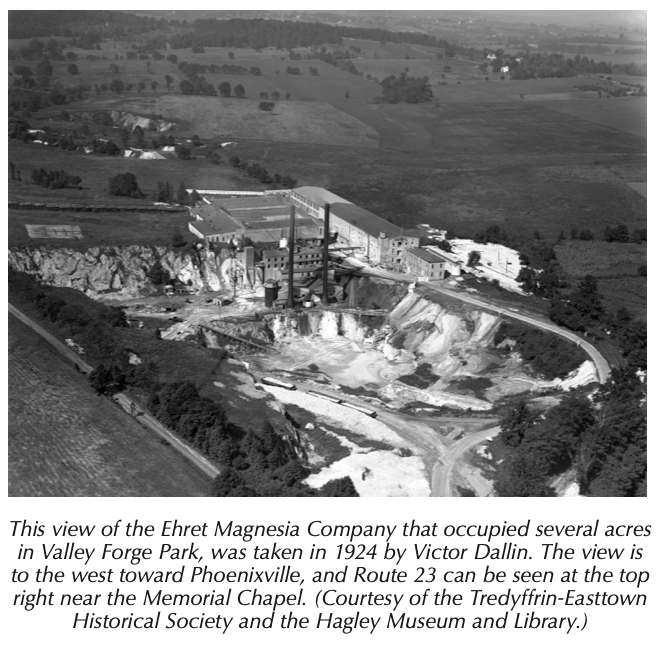
The manufacture of magnesia products was another use for the dolomitic limestone of the Great Valley. This is calcium magnesium carbonate, not the calcium carbonate of normal limestone. Between … 1877 and the construction of their first buildings in 1895, the Ehret Magnesia Manufacturing Company started buying up and consolidating many of the smaller Port Kennedy quarries. … the magnesium content—carbonate of magnesia—of Port Kennedy limestone was as high as 42% (vol. 1, p. 26)—very high.
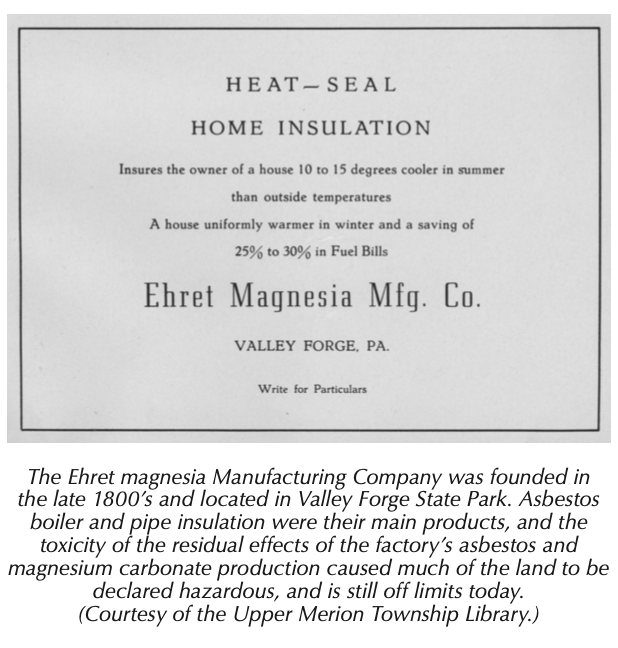
Asbestos is a naturally occurring mineral silicate with strong white fibers. The insulating and flame retardant qualities of asbestos were known as far back as ancient Rome and by the Industrial Revolution at the end of the 1800s, asbestos was used in the manufacture of thousands of products. By the 1970s the health hazards of asbestos had become known.
This was what Ehret was manufacturing in Valley Forge. They specialized in what were called 85% magnesia products—insulating pipe covers, insulating blocks, and felt fiber. The 85% was the magnesia; the other 15% was the mineral silicates—the stuff that causes asbestosis and mesothelioma. Over the course of its 80-year history in Valley Forge, Ehret built 20 buildings.
… During World War I Ehret was manufacturing insulation products the U.S. Navy needed at the same time the park was planning to acquire—by demolition—land on which plant workers’ houses stood. The commission delayed its plans in support of the war effort. After the war, Ehret planned to spend $100,000 to build new workers’ housing and make other improvements to its plant site next to the park. Ehret refused to cooperate when the park commission resumed its demolition of workers’ houses and the commission retaliated by declaring Ehret’s new proposed housing tract a future part of the park…
… As the company grew, its name was changed to the Baldwin-Hill Company, in 1959 to Baldwin-Ehret-Hill, Inc., and some time in the 1960s or early 1970s it was purchased by the Keene Corporation, a Fortune 500 company. By that time the plant was completely surrounded by land owned by the park. Keene continued manufacturing insulating pipe covers and blocks, felt products, and insulating cement. Between 1925 and the early 1970s Ehret and its successors disposed of waste products from manufacturing operations directly into the Schuylkill River and through a slurry pipeline into several of the inactive limestone quarries.
… in 1975 the U.S. Department of the Interior recommended that the Keene property be purchased and gave an estimated cost of $3,878,450 (p. 559). The plant was closed in 1976 and the rail spur was abandoned. On October 13, 1976 the National Park Service purchased the 46-acre Keene property and the asbestos manufacturing plant. The site had been heavily vandalized and the park razed several of the buildings in 1978.
… In January 1997, while installing underground fiberoptic cable in the amphitheater area, the park discovered asbestos in the soil. The U.S. Environmental Protection Agency was brought in and between May and October of 1997 emergency response action was taken to abate immediate risks to public health and the environment in all quarry and related areas. All quarry buildings and structures were demolished and buried and, since these areas were popular with hikers and rock climbers, all access was restricted.
Today it is nearly impossible to determine the location of the Ehret/Keene site. If you drive along County Line Road to the point where you can look north across the rolling hills and see the Washington Memorial Chapel bell tower in the distance, the land just to your left in front of you is where it was.
Something Unusual Is Going to Happen At Wayne
Just one hundred and fifty years ago this winter, George Washington and his troops were encamped between Wayne and Valley Forge. Nowhere else in America does the true spirit of Colonial times linger as it does among the picturesque hills of this historic region.It is most fitting that a spot so rich in Revolutionary tradition should serve as the background of a group of homes in which the Colonial atmosphere is to be faithfully recreated. Such a colony – a veritable Colonial village, in fact – is about to be founded on a five hundred acre tract of the choicest countryside in the Martin’s Dam section, 6 minutes by motor north of Wayne Station.
These single homesteads will occupy sites varying from one and one-half to five acres, and will be built in the true Colonial or the closely related Georgian styles. Some will be of stone, others of brick or clapboard. There will be replicas of Mt. Vernon, Montecello, and other early American mansions. Absolute fidelity to period detail will be pleasingly blended with the appointments of a luxurious modern home. There will be old Colonial plank floors, forged iron hardware, real Colonial mantels with large white log-burning fireplaces, and quaint period electrical fixtures. These homes will have five and six bedrooms and three baths. Prices range from $25,000 to $40,000.
Here is an ideal location for the man who wants to live in the country, and yet keep in close daily touch with his business. There is thirty-minute express service (no change of cars), on the P.R.R. Main Line from Wayne to Broad Street Station, with eighty trains daily, and a commutation rate of sixteen cents. In addition there are 134 trains a day on the Philadelphia and Western R.R., and bus services along the entire Main Line.
Adjoining this tract is the new “Chester Valley Stables” riding academy, from which one may take daily rides over the beautiful countryside and through the Valley Forge Park of 2,500 acres. A polo field and steeplechase course will shortly be added to its facilities. The new St. Davids Golf Club is within walking distance to the south, while adjoining this tract to the north is the newly completed Valley Forge Golf Course. Directly east, and practically adjoining, is the “Bob White Farm”, home of the Chester Valley Hunt. At Wayne is a new motion picture theatre with 1500 seating capacity. Wayne also has numerous fine stores and public, parochial and private schools. Six churches.
The tract is bounded on three sides by State highways, with improved and widened tarvia roads running through the property. All streets are electrically lighted and there is Springfield water service. Quaint sign posts have been placed throughout the settlement.
One of these homes will soon be completely furnished in the Colonial manner. Plots of from one and one-half to five acres are available for those desiring to build their own homes in this highly restricted Colonial Village.
See the large model of each homestead and a most unusual ten-foot painting of this section a the office of J. Howard Mecke, Jr.

1929 aerial view of the J. Howard Mecke real estate development of Colonial Village looking northwest. Lower right corner is Warner Rd, with Pugh Rd going from lower right to upper left, while the horseshoe-shaped road at right is Lafayette Rd. (Dallin image courtesy of the Tredyffrin-Easttown Historical Society and teh Hagley Museum and Library.)