Remember any of these restaurants? Here are some of their ads from the 80s, along with a few of their Thanksgiving specials.


Remember any of these restaurants? Here are some of their ads from the 80s, along with a few of their Thanksgiving specials.
The November 1989 Tornado Outbreak was a destructive tornado outbreak on November 15 and 16, 1989 across a wide swath of the southern and eastern United States and into Canada. It produced at least 40 tornadoes and caused 30 deaths as a result of two deadly tornadoes. The most devastating was the Huntsville, Alabama tornado, an F4 which killed 21 on the afternoon of the 15th. Eight more fatalities were reported at a single elementary school by a downburst on the 16th in the Town of Newburgh, New York. Several other significant tornadoes were reported across 15 states.
Check out the accompanying Today’s Post photos and articles about the damage in King of Prussia.
Here is an excerpt from the Friday, November 17, 1989 Philadelphia Inquirer article, Fierce Winds Rip Through Area.
…According to the National Weather Service, the unusually sever storm front – the meeting of a low pressure zone from the Great Lakes and a mass of warm, moist air here – passed through the region between 10:15 am and noon, with winds up to 100 m.p.h.
A tornado touched down in the Allendale Road area of King of Prussia at 10:45 a.m…. …In Montgomery County, a tornado raced through the King of Prussia section of Upper Merion, damaging homes and offices and leaving three office works cut from flying glass.
Sheets of corrugated metal and other roofing materials were blown off a large section of a two-story office building at 475 Allendale Rd. and were scattered several blocks across a neighborhood of split-level homes.
William Schmidt, whose house sits directly across Allendale Road from the office building, said he was in a front room when “I just heard what sounded like a lot of hail. Then it got dark and the windows started to smash.” What he had thought was hail turned out to be gravel from the office building roof, he said. Two men and a woman who worked at the office building, which houses offices of the U.S. Nuclear Regulatory Commission and other federal agencies, were treated for multiple cuts at Sacred Heart Hospital in Norristown.
The storm also cut a two-mile swath across the northern portion of Upper Merion Township, where it overturned three construction trailers, tore the roof off an office building, blew down a barn and ripped shingles from dozens of homes….


Upper Merion student, Fred H. Salter, who grew up in Gulph Mills, was a 1940 graduate of Upper Merion High School. In his novel, Recon Scout, Fred described his growing up in Gulph Mills, his enlistment, and his service in Africa and Europe.
He wrote that his parents migrated to Pennsylvania from England and Wales after World War I, when his father received his discharge from the British Royal Air Force. His folks originally intended to continue on to Australia. Instead, his dad found work in America and decided to settle here. Fred was born August 19, 1922 in Gulph Mills to Frederick Evan and Ethel M. (Jordan) Salter. He recorded that he grew up in the hills of Pennsylvania, ran a trap line, and played fiddle in a hillbilly band at barn dances.
Salter’s army career began with a controversy. “Standing outside the recruiter’s office, I leaned against the building and signed my father’s signature to the enlistment papers. Having the same name as my dad’s, I figured I wasn’t being completely dishonest. If only the army allowed a young boy to enlist without his parents’ consent. I wouldn’t have felt guilty. I thought to myself, ‘For what greater cause need a person bend the arm of the law, than for the opportunity of defending his country. If I’m guilty of a wrongdoing, then so be it.’” He joined the U.S. Horse Calvary while a teenager, fought in North Africa as a recon scout from 1942–1943, then in Sicily in 1943, and also in Italy in 1944.
The return of the service men and women was captured by Fred Salter when he recalled his coming home, as recorded in Recon Scout. The feelings and emotions of his neighbors, himself and probably most township residents and American citizens were captured in his recollections. He reminisces about how the P&W rolled along past villages that he remembered as a boy. Leaving the bullet-shaped car, he stepped out onto the wooden platform and not a soul was in sight. It was a lonely welcome he remembered, but at the same time, that was the way he wanted it.
Once he got off the train, he walked through the woods into the village of Gulph Mills and knew that he was home. No brass band welcomed him. He decided not to walk directly home and surprise his mother; the shock might be too much for her. He went down to the country store in the village to call her. When she picked up the phone, he asked if he could speak to Fred. Not recognizing his voice, she told him that she had not seen Fred
since 1942 and she thought that he was still somewhere in northern Italy.
He proceeded to ask her if she was sitting in a chair and the worst fear came over her. She began to cry. He then told her that this was Fred, her wandering boy. She wouldn’t believe him until he sang The Little Shirt Me Mother Made for Me, the song his father sang in Wales as a young boy.
He walked through the village and everyone came out to greet him. No, there was no brass band, but there was the rhythmic beat of steel pounding against steel. The ringing floated out from beneath the branches of the apple tree next to old Dan McDermott’s blacksmith shop. To Fred, it seemed like Dan was playing The Anvil Chorus.
When he met some people in the village, he noticed that their eyes moistened and he realized that many families had lost loved ones. His coming home must have reminded them that they would never enjoy such a reunion.
Gulph Mills is nestled between steep wooded hills, and Fred recognized that the shadows had lengthened by the time he reached the far side of the village. Before he opened the wooden gate leading to the front yard, he leaned against the giant oak tree that grew beside the road. He stood for a moment and watched his gray-haired mother rocking back and forth in her chair on the porch. Unaware he had arrived in the village, she was busily knitting a scarf for some unknown soldier boy in Europe.
Fred walked up behind her and spoke and tears filled both their eyes.
Later when his dad, sister Ethel, and brother George returned from work, he was welcomed with open arms. He reflected that the trouble he had caused when he left home and joined the army would never be forgotten, but no one ever mentioned it. His folks were just thankful that he had returned safely.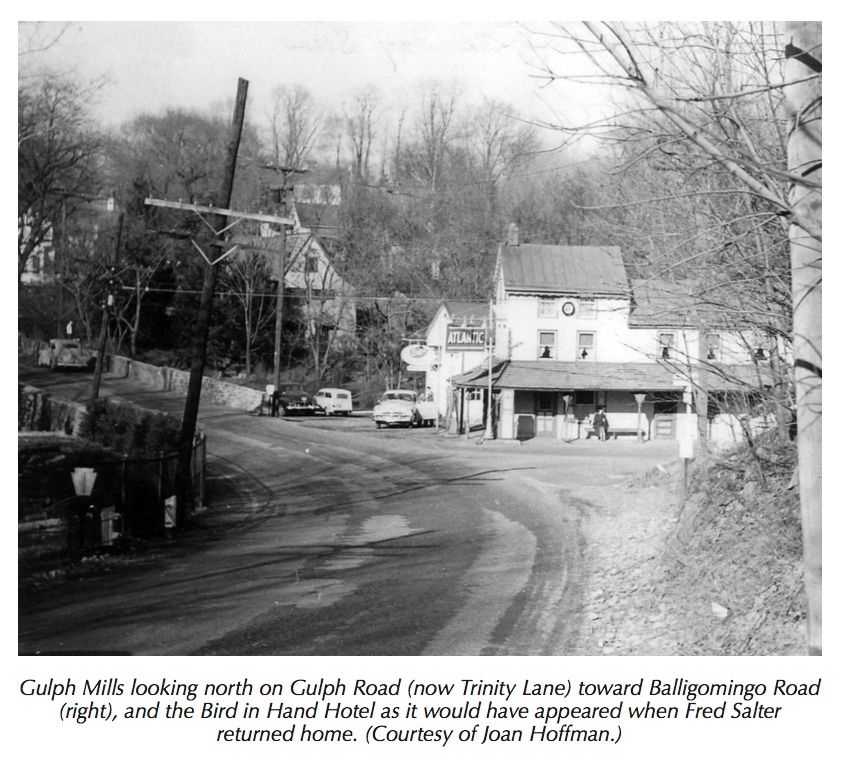

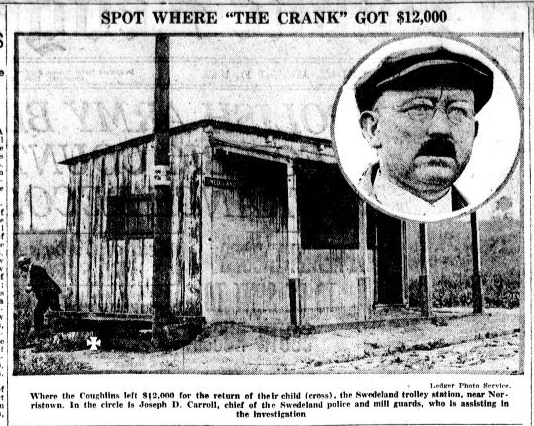
The Swedeland trolley station was that ‘spot where “the crank” got $12,000’ back in 1920. Read more about the famous “Coughlin Kidnapping” case in this 8/27/15 post by the Montgomery County Historical Society:
A few weeks ago, HSMC [and King of Prussia Historical Society] member James Brazel was in the headquarters doing some research in our microfilm collection, when he came across one of Montgomery County’s most notorious crimes: the kidnapping of baby Blakely Coughlin from his family’s home in Plymouth Township.
Thirteen month old Blakely was kidnapped from his nursery at 2 am on June 2, 1920. The kidnapper was an Italian immigrant named Augustus Pasquale (spelled Pascal in the early reports) who got the idea one night when he saw the family through their window while he was walking to the train. Pasquale took a ladder from a nearby house, climbed through the window and took the baby from his crib. He buttoned the baby up in his coat as he went from the house, and after a little while he discovered that he had smothered the child. He then went to the Schuylkill, tied the small body to a piece of iron, and put both in the river.
Then he sent several demands for ransom to the Coughlin family signing them, “The Crank.” Though the family was not very wealthy, the boy’s father, George H. Coughlin, managed to raise $12000. He left the money at a trolley station in Swedeland. When the baby was not returned the state police, under Lynn Adams, stepped in. It was by agreeing to pay another $10000 ransom, that the police managed to trap Pasquale. This time, Coughlin was instructed to throw the money from an Atlantic City bound train when he saw a white flag waving along the tracks. Adams had lined the tracks with state police, and when Pasquale appeared to retrieve the bag, he was arrested. He later confessed and plead guilty to second degree murder, kidnapping, and extortion. Since Blakely Coughlin’s body was never recovered, first degree murder charges could not be brought, and Pasquale escaped the death penalty.
And that’s certainly an interesting story. But I wanted to know more, so I went to our microfilms of the Times-Herald to follow the case in “real time.” Day after day through the month of June and into July, the Times-Herald covered the story. Theories about the case abounded in the early days, with the newspaper reporters asserting that the kidnappers must be a man and a woman based on some footprints. The county commissioners offered a reward for the return of the baby.
Various suspects were brought in, questioned, and released. There were at least a half dozen sightings of babies, in Pittsburgh, New York, and as far away as Arkansas. The Herald blamed police for not doing enough and conducted it’s own investigation. In the 1940’s and 1950’s, Pasquale repeatedly applied for parole, citing his age and poor health. He also changed his story, often in ways that matched the early reports. He claimed to have had accomplices, one a former servant of the family. Later he said he kidnapped the baby with a woman who was desperate for her own baby. Other times he claimed to be completely innocent.
In 1957, Pasquale, nearly blind and suffering from cancer, was released, but he soon violated his parole by leaving the state. He said he had gone in search of the other people involved in the kidnapping. After he was arrested, but before he confessed, Pasquale had also claimed to have accomplices.
Reading through the day to day details of the case, helps me to experience the events, the way someone in 1920 experienced them. All the details and the false leads because part of the story, too. The sweetest and saddest parts, of course, were the quotes from Blakely’s parents. His father was asked to describe him in the very first article: “He was a husky boy of thirteen months. He had blue eyes and a fat round face and light hair.”
https://hsmcpa.wordpress.com/…/…/27/the-coughlin-kidnapping/